|
"Archadia" - Finding a Way Through the Noise
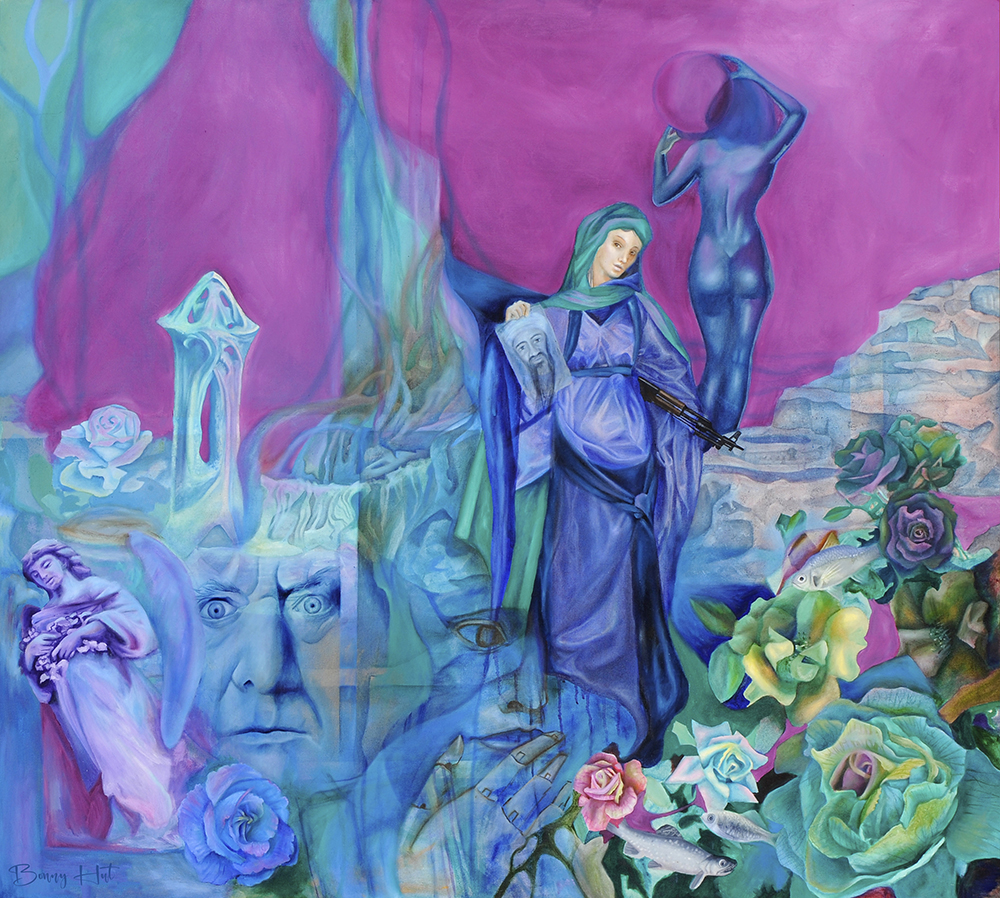
Large surrealist oil painting.
Painted in 2001, against the unsettling backdrop of the
September 11 attacks and the fall of the Twin Towers, Finding a Way Through the
Noise emerged from a moment when the world seemed to shift into something
strange, frightening and difficult to understand.
Rather than attempting to
explain that moment, the painting captures the psychological atmosphere of it —
the confusion, contradictions, unanswered questions and overwhelming flood of
information that confronted ordinary people.
It is a dreamlike landscape where
beauty and violence, innocence and knowledge, spirituality and human conflict
exist side by side. At the centre stands a mysterious woman dressed almost like
a medieval traveller or guardian. She holds a newspaper image of Osama bin
Laden, taken directly from a newspaper by the artist as reference, while a
rifle rests across her body. She is neither presented simply as victim nor
aggressor. Instead, she becomes a kind of witness — a figure caught in the
uncomfortable position of trying to understand events that seem far larger than
herself. Her expression is calm and almost contemplative, creating a striking
contrast with the implications of the objects she carries. Behind her, another
woman stands nude, balancing a great vessel upon her shoulder. Her
vulnerability and openness contrast sharply with the central woman's layers of
clothing and guarded posture.
The two women almost seem to represent opposing
states of being: one exposed to the world, the other protected from it; one
carrying something openly, the other carrying the weight of knowledge, fear and
responsibility. Their relationship is deliberately ambiguous. Are they two
aspects of the same woman? Are they opposing forces? Perhaps one represents the
raw, instinctive human self while the other represents the conscious mind
trying to make sense of an increasingly incomprehensible world. They occupy the
same strange landscape, but appear to exist within entirely different
realities.
At the lower left, an angelic figure rests beside the stern portrait
of a man. Looking closer, another face begins to emerge — almost mechanical or
robotic — its hand covering its mouth. These figures create another quiet
conversation within the painting.
The angel suggests spirituality, protection
or innocence; the stern face suggests authority, judgement or certainty; while
the strange mechanical figure appears unable — or unwilling — to speak. Behind
them rises an otherworldly obelisk-like structure beside a delicate rose. The
architecture feels ancient and almost sacred, yet strangely unfamiliar, as
though the scene exists somewhere between a civilisation remembered and a
civilisation imagined.
Nothing quite belongs where it has been placed, yet
everything seems connected. On the opposite side of the painting, fish drift
and swim amongst roses. Their presence introduces a softer but equally
mysterious language. Fish can evoke the unconscious, intuition and the hidden
depths of the psyche, while roses suggest love, beauty, transformation and the
inevitable thorns that accompany them. Together they become a poetic metaphor
for the search beneath the surface — the attempt to find truth, meaning and
beauty hidden within confusion.
The entire painting is built upon contrasts:
clothed and naked, beauty and violence, ancient and futuristic, spiritual and
mechanical, silence and speech, tenderness and threat. Even the colours carry
this tension, with luminous blues and turquoise colliding with intense pinks
and purples, creating an almost dream-state atmosphere. Perhaps the central
woman is ultimately all of us — standing in the middle of a bewildering
landscape, surrounded by fragments of information, belief, fear, beauty and
contradiction, trying to determine what is real and what is merely noise.
When
this painting was created, the artist chose not to sell it. For more than two
decades it remained with her, perhaps because the work belonged to a particular
moment in her own journey — a visual record of a time when the world suddenly
seemed surreal. Only now has she decided to release the original for sale.
Finding
a Way Through the Noise is therefore more than a painting about a particular
historical moment. It is a painting about what happens when certainty
disappears — and the individual is left to navigate the strange landscape of
human experience, searching for their own way through the noise.
|