|
Rape of the Land
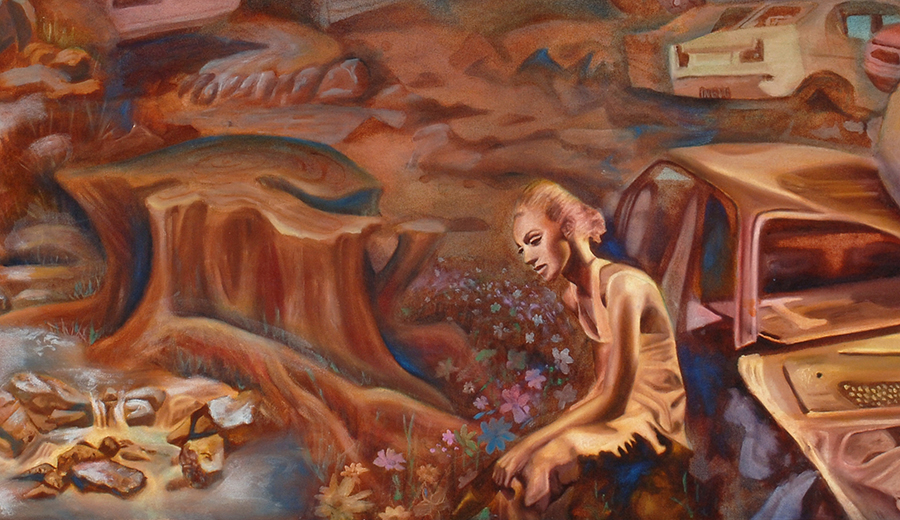
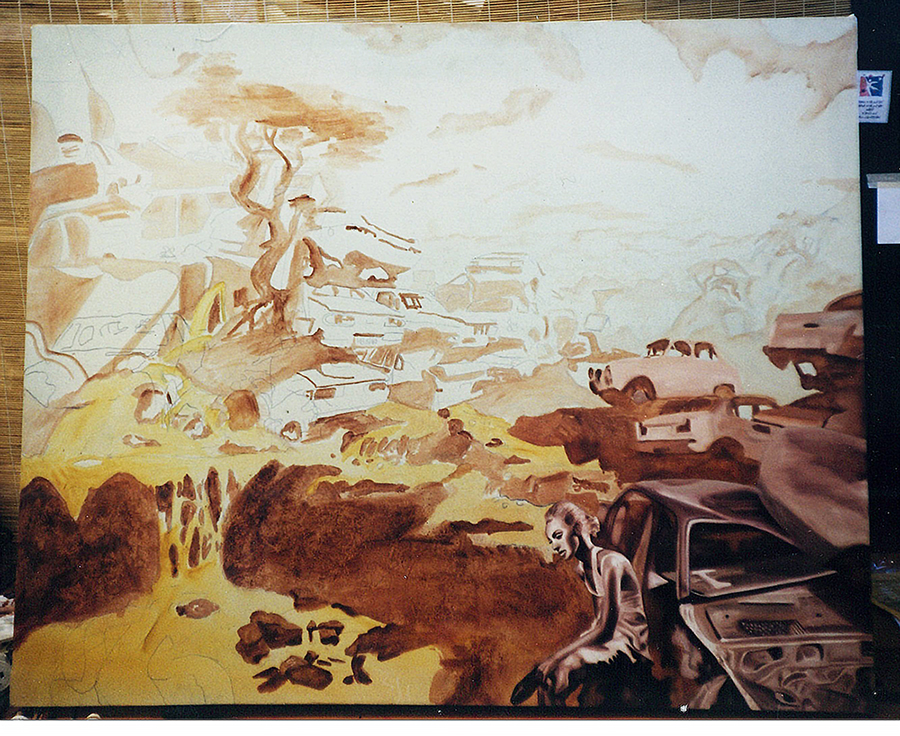
Rape of the Land is a haunting surrealist landscape about
the uneasy relationship between humanity and the natural world.
The painting
grew from the artist’s travels through New Zealand’s South Island, where she
encountered a forgotten car yard filled with old, abandoned vehicles. She
stopped to photograph the scene, never knowing that these images would later
become the visual seeds for this strange and contemplative work.
At the centre
sits a solitary woman beside the enormous stump of an ancient tree. She appears
quiet and almost mournful, as though she is listening to something only she can
hear. From beneath the severed tree, water continues to flow, creating a small
waterfall — a powerful reminder that nature persists even after it has been cut
down. Around her, the discarded cars have accumulated like the remains of
another civilisation. They climb over the landscape, rusting and decaying,
while grasses, flowers, rocks and water slowly begin to reclaim the spaces that
humans have abandoned.
The cars represent industry, consumption and human
intrusion; the tree and flowing water represent something older, quieter and
more enduring. There is an intimate relationship between the woman and the tree
stump. She seems almost like a witness at its grave, while the tiny flowers
growing beside her suggest that death and renewal are never completely
separate. Perhaps she is mourning what has been lost — or perhaps she has
simply stayed long enough to see nature begin taking its territory back.
The
painting inspired the artist to write “The Song of the Ancient Tree,” a poem
that was published alongside the painting in her art journal Explorations of
the Mirror. Together, the painting and poem become a lament for the natural
world — but also a quiet reminder that beneath the machinery, the wreckage and
the scars we leave behind, the land is still singing, still flowing, and still
finding a way to reclaim itself.
|