|
"Osiris"
He is the god who died, and who taught us that death is not
the end.
In Egyptian mythology, Osiris is the green-skinned king of the
afterlife, of resurrection, of the fertile Nile that floods and returns.
Murdered and dismembered by his jealous brother Set, his body scattered across
Egypt, he was gathered and reassembled by his wife Isis — all except for one
piece, lost to the river and swallowed by a fish. He rose again, not as the
king of the living, but as the sovereign of the dead, the judge, the promise
that what is broken can be made whole.
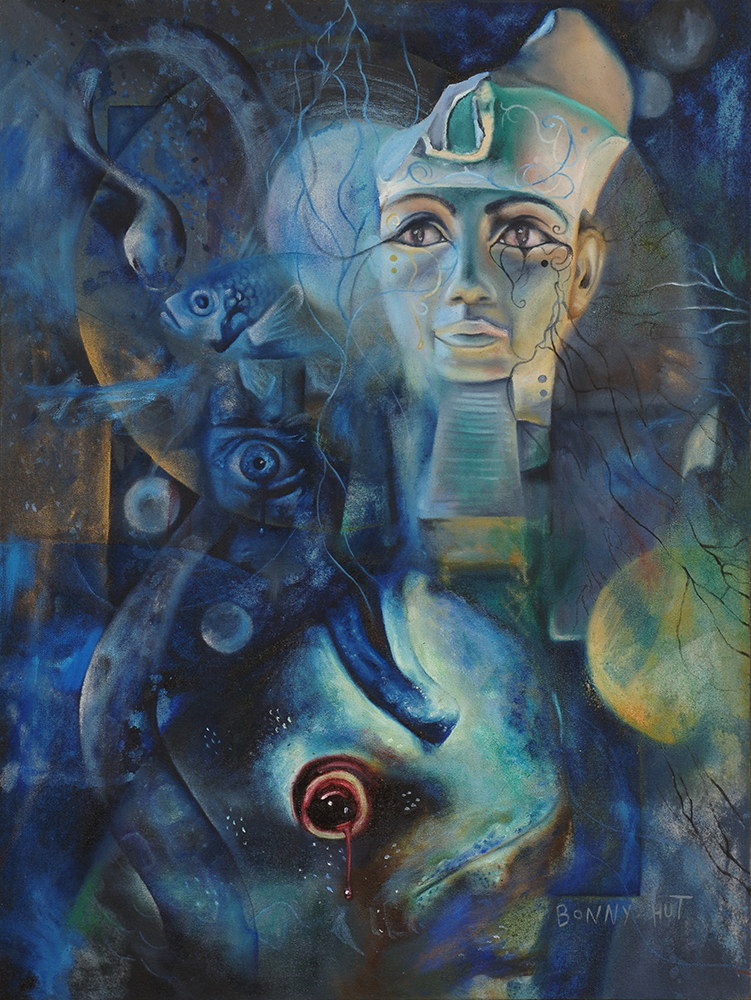
This painting holds that sacred,
sorrowful moment in its blue depths. Above, Osiris gazes out — serene,
androgynous, eternal, his white Atef crown cracked and luminous. Tears like
silver threads run from his eyes, not in grief, but in deep, cosmic compassion.
Below him, dominating the canvas, is the Fish — not just an animal, but the
witness, the keeper of the lost part, the creature of the unconscious Nile. Its
eye weeps a single drop of blood-red life. Look at the relationship: They are
bound by water and light. Wispy electric lines like river veins or soul threads
connect Osiris's crown to the fish's body.
A smaller ghost-fish swims between
them, between his thoughts. The blue Eye of Horus watches from the shadows —
Osiris's son, the avenger, the future. The moon-like orbs float like lost
fragments of his body, slowly finding their way home.
Painted in deep indigo,
aqua and bruised gold, this is a portrait of sacred loss and return. Osiris
does not rage at the fish that took a part of him. He floats above it, blessing
it. Because he knows what we forget: that even what devours us is part of our
resurrection.
|